What you're seeing
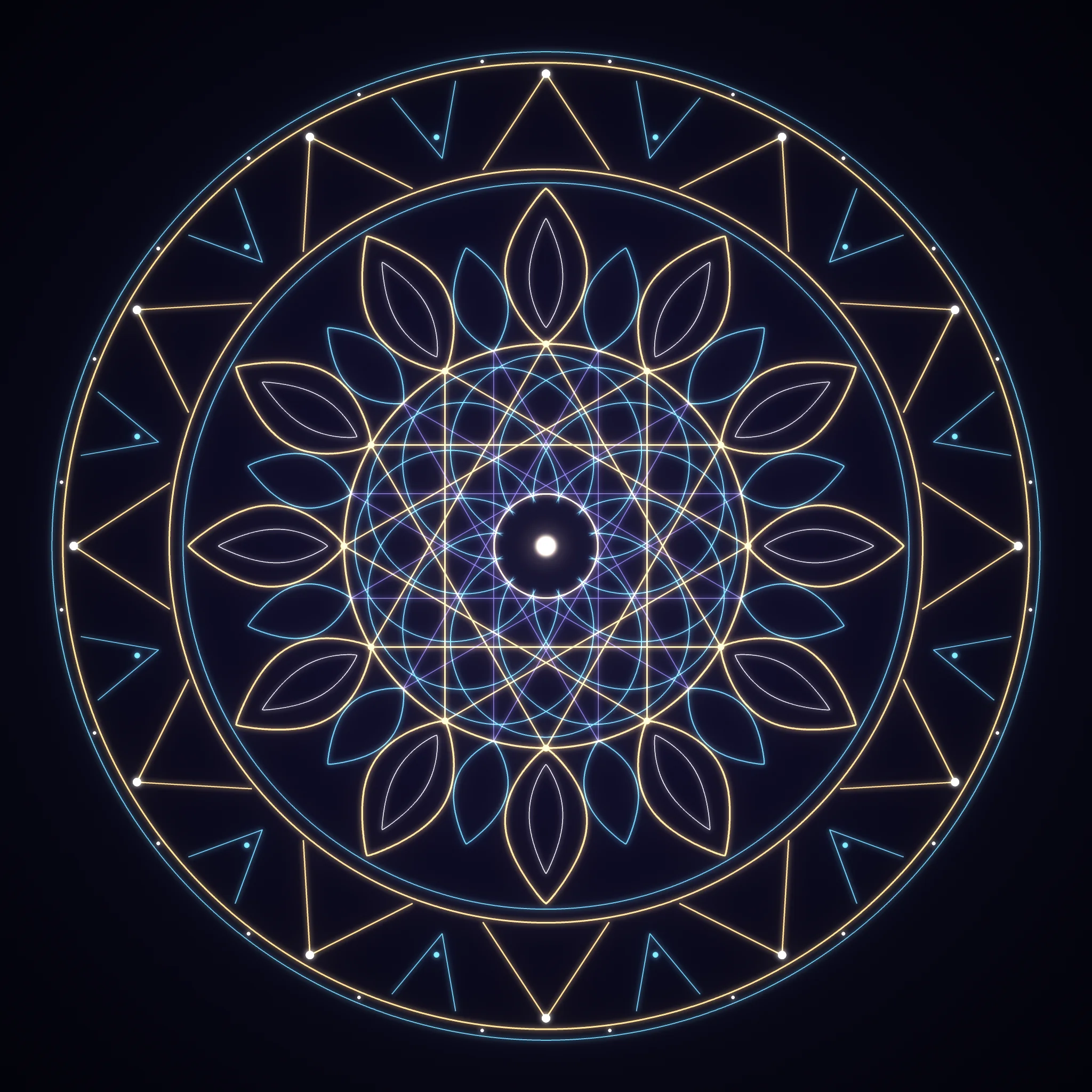
Our turning mandala is built from rings, petals and rays arranged around a single point. As it slowly rotates, the outer edges are always in motion while the very center barely moves. Many people find that their gaze settles there by itself, and that the movement around it starts to feel less like something to follow and more like something to rest beside.
Radial patterns like this have a special place in human vision. To see why, it helps to go back about a hundred years.
Klüver's form constants
In the 1920s the psychologist Heinrich Klüver studied the visions people reported under the influence of mescaline. Amid all their variety, he noticed that a few basic geometric forms kept coming back, and he called them form constants (Klüver, 1926; his work is collected in Klüver, 1966). They are usually grouped into four types: gratings and lattices (including honeycombs and checkerboards), cobwebs, tunnels and funnels, and spirals.
Mescaline turned out to be only one route. Later researchers note that similar patterns appear with flickering light, with certain anaesthetics, with deep pressure on the eyeballs, and in the drowsy moments of falling asleep or waking up, and they may even be preserved in ancient petroglyphs and cave paintings (Bressloff et al., 2001). Because these patterns are seen with both eyes and move when the eyes move, they are thought to be generated in the brain rather than in the eye itself (Bressloff et al., 2002).
What the science says
In 1979 the mathematicians Ermentrout and Cowan proposed an explanation. Their starting point was a known feature of the brain's wiring: the image on the retina is mapped onto the primary visual cortex (V1) in a distorted way that roughly follows a mathematical function called a complex logarithm (Schwartz, 1977). Under this mapping, circles centered on your point of gaze become roughly parallel straight lines in the cortex, and rays running out from the center become lines at right angles to them.
Ermentrout and Cowan showed that if activity in V1 spontaneously organizes itself into simple stripes or spots, as networks of excitatory and inhibitory neurons can do when they become unstable, then translating those cortical patterns back through the map produces the tunnels, funnels, spirals and lattices people describe. Bressloff and colleagues (2001) extended the model to include the way V1 cells respond to the orientation of edges, which accounts for the cobweb and lattice forms too. Billock and Tsou (2012) review how this links elementary hallucinations to pattern-forming processes studied throughout physics and biology.
Put simply, the radial, ring-like and spiral geometry of the form constants seems to mirror the layout of our own visual system. That much is well-supported theory. Whether looking at a radial design such as a mandala engages this machinery in any special way has not, as far as we know, been directly tested, so treat the connection that follows as interpretation.
Mandalas across traditions
In Hindu and Buddhist Tantric traditions, a mandala is a symbolic diagram used in sacred rites and as an instrument of meditation. It represents the universe, and the practitioner mentally “enters” it and proceeds toward its center. A Tibetan painted mandala characteristically has a square at its heart, surrounded by concentric circles and by borders of fire, diamonds, graveyards and lotus leaves. The related Hindu yantra is a linear diagram used in ritual and meditation (Encyclopædia Britannica).
In the twentieth century the psychiatrist Carl Jung noticed mandala-like circles in his patients' drawings and saw them as a sign of movement toward psychological wholeness, a process he called individuation (Jung, Mandala Symbolism). Jung's psychological reading differs in important ways from Buddhist understanding, but both treat a circle organized around a center as an image of order.
The meditation connection
This section is our interpretation, offered as a way of practicing, not a research finding.
A slowly turning mandala offers the eyes two things at once: motion all around the edge, and stillness at the center. Instead of chasing the movement, the exercise invites you to rest at the center and let the turning happen around you.
Thoughts, sounds and sensations can be met the same way, as movement circling a still point of awareness that does not itself need to move. You are not trying to stop the turning. You are noticing that you can be at peace in the middle of it.
Keep sessions short and comfortable. If the motion makes you dizzy or uneasy, look away or close your eyes.
Sources
Klüver, H. (1966). Mescal and Mechanisms of Hallucinations. University of Chicago Press.
Encyclopædia Britannica. Mandala.