Daily practice
Three short visual exercises. In each one you watch perception change, and notice that the awareness seeing the change stays the same.
Find a quiet spot and give yourself a few minutes. If you can, make the page full screen (F11 in most desktop browsers, Control-Command-F on a Mac), sit back and let your shoulders drop.
Exercise 1
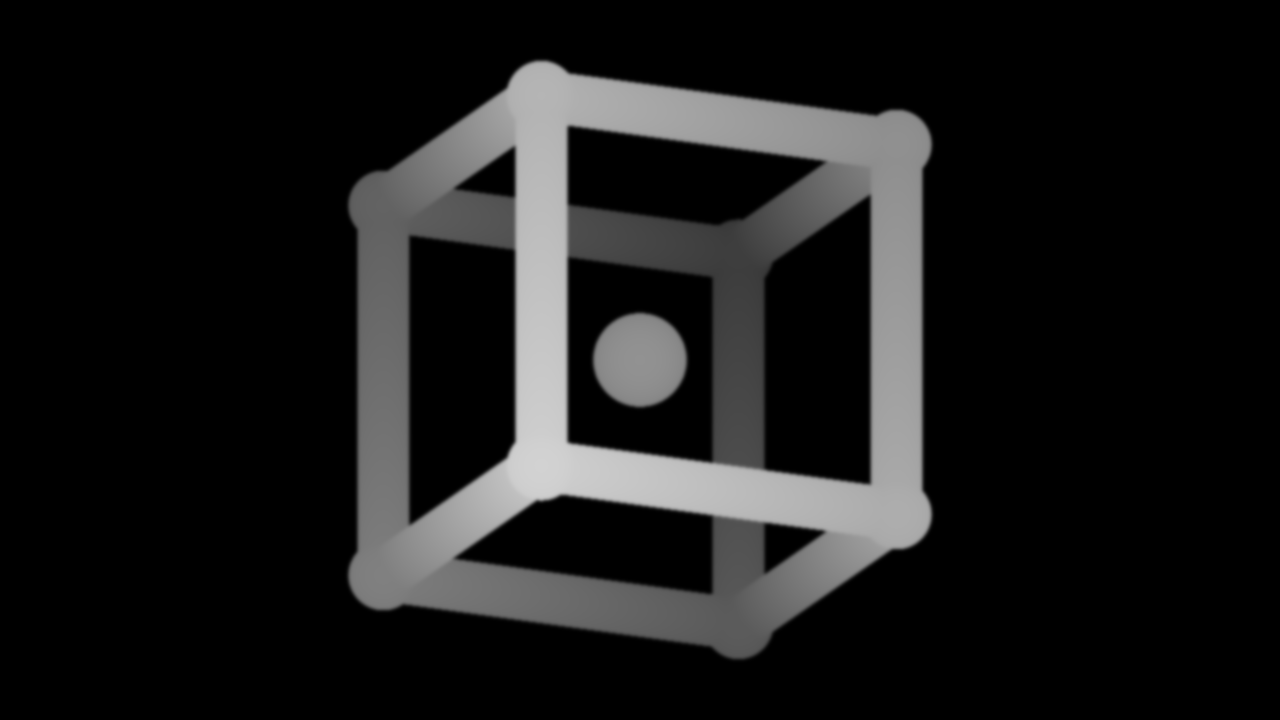
A Necker cube is a simple line drawing that the brain can read in two ways. The lines never change, yet what you see does.
1. Rest your eyes on the small dot in the center.
2. Breathe with the cube: in as it grows, out as it settles. Each full breath takes about six seconds.
3. Keep watching. At some point the cube flips and seems to face the other way. Notice the moment it happens.
4. Then notice what didn't flip: the awareness that saw both versions.
5. If the cube will not flip, slide your hand slowly across the drawing, covering part of it, and look again as it reappears. The flip usually comes on its own.
Tip: you can flip it on purpose. Imagine the other square face is the one in front, and the cube turns to match.
The drawing gives your brain two equally good answers to one question: which square is in front? It settles on one, and after a few seconds the other takes over. Nothing on the screen changes; the switch happens entirely in how your brain interprets the lines. Researchers call this bistable perception, and it is one of the clearest ways to watch the mind building what you see.
Go deeper: the Necker cube →Exercise 2
This magic eye image, also called an autostereogram, hides a 3D shape inside a field of repeating dots. Your eyes find it by relaxing, not by trying harder.
Best on a larger screen: a laptop or desktop at 100% zoom. It can work on a phone, but the hidden shape is small there, so turn your phone sideways to make the image as wide as possible.
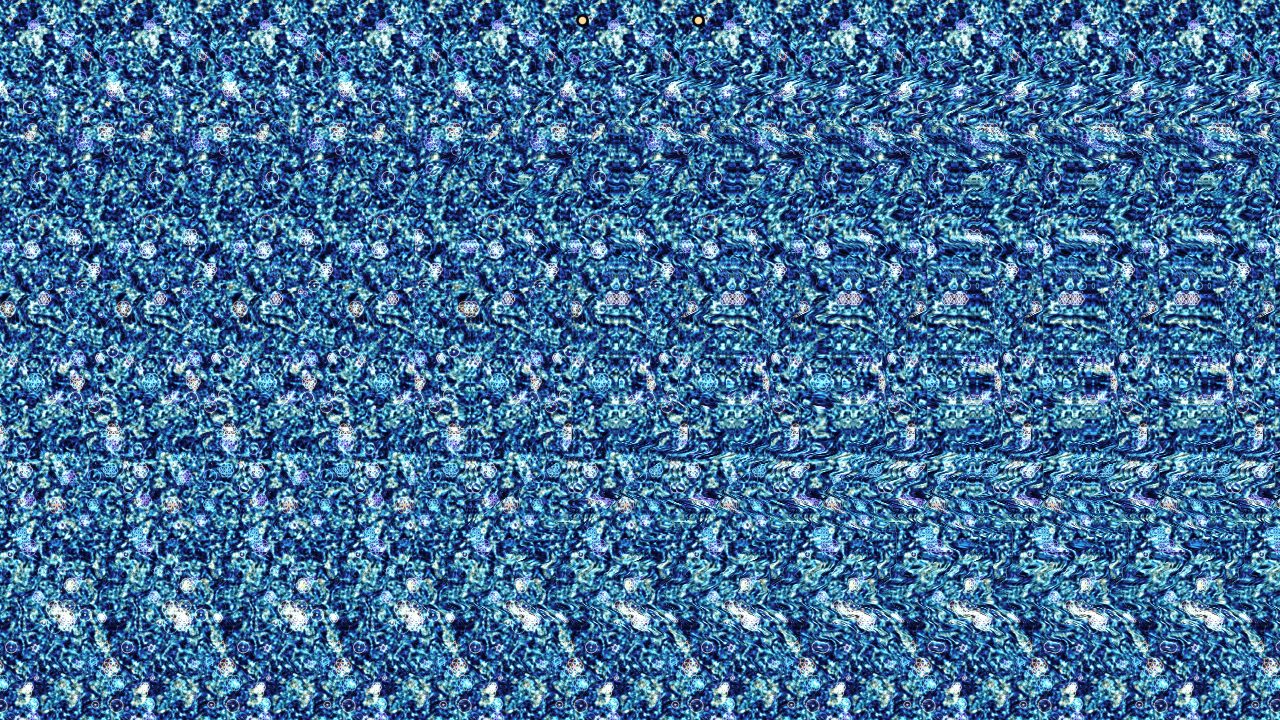
1. Bring your face close to the screen, so the image goes soft and blurry.
2. Relax your eyes as if you were looking through the screen at something far behind it.
3. Keep that relaxed gaze and slowly move back.
4. Watch the two gold dots at the top. When they become three, hold steady: a wireframe cube with a small sphere at its center floats up out of the pattern.
The moment it locks in, notice that the image appeared without the screen changing at all. Every dot was already there. What changed was how they were seen.
If it doesn't come today, that's fine. Use the button to see what's hidden, then try again another time. The image keeps its proportions at any size, but it works best on a larger screen at 100% zoom.
The pattern repeats across the image, and the hidden shape is encoded in tiny sideways shifts between the repeats. When your eyes aim behind the screen, each eye lines up a different repeat, and your brain reads those shifts as depth, the same cue (binocular disparity) it uses to see the real world in 3D. The shape is not drawn anywhere in the picture: it exists only in the image your brain builds from the two views. Here it is a Necker cube with a small sphere at its center, and unlike the flat drawing in Exercise 1, it doesn't flip: in 3D, depth tells your brain which face is in front.
Go deeper: how magic eye images work →Exercise 3
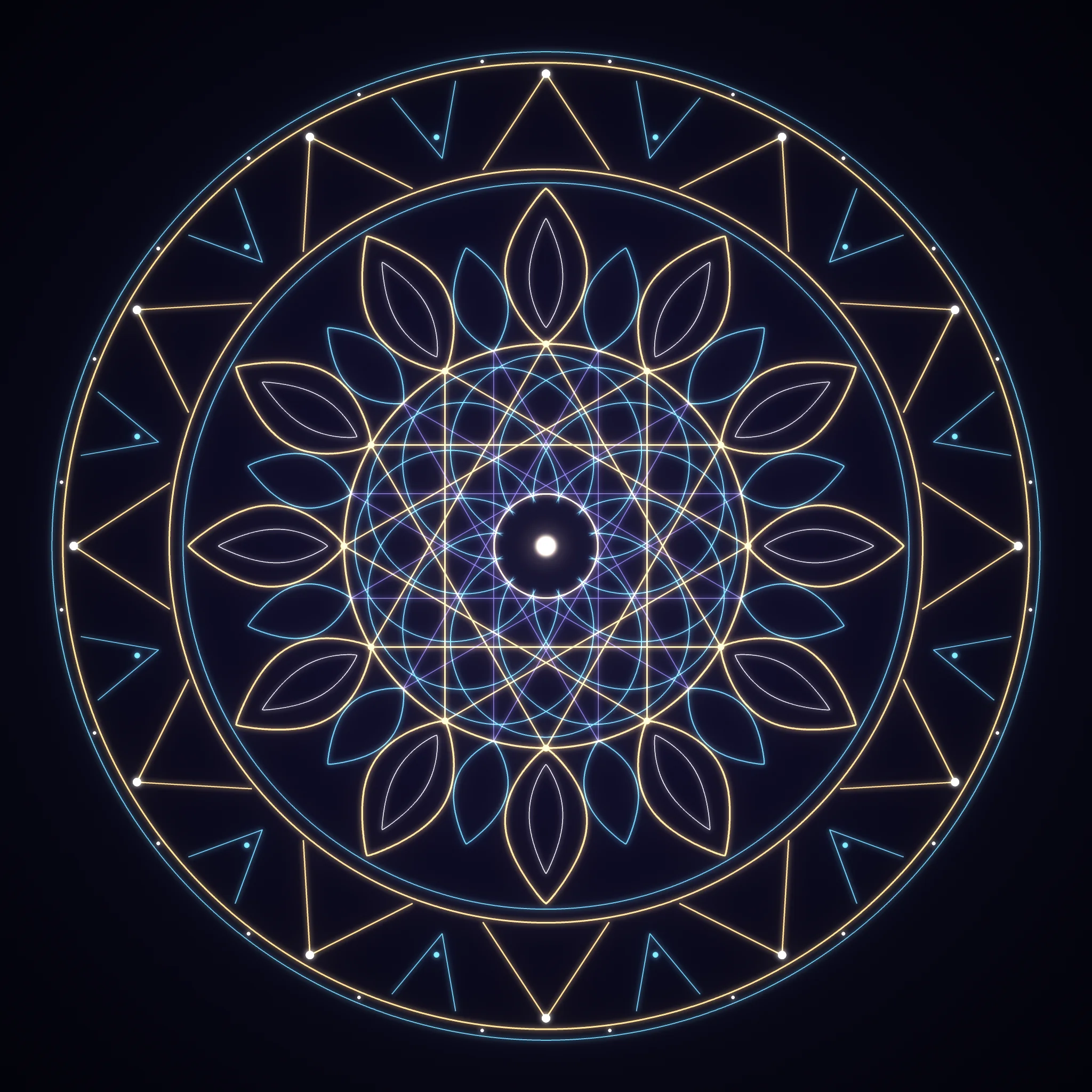
A slow, symmetrical pattern to rest your gaze on. It turns and gently glows, while the point at its center stays exactly where it is.
1. Let your gaze go soft and rest on the bright dot in the center.
2. Don't follow the pattern. Let it move at the edges of your vision.
3. Notice the slow six-second glow, and let your breathing match it if that feels natural.
4. Notice that the center stays still while everything around it moves, like awareness itself.
If reduced motion is turned on in your device settings, the cube and the mandala stay still. They still work as a quiet place to rest your eyes.
Photosensitivity note: the mandala turns slowly and its glow gently brightens and dims. If you have photosensitive epilepsy or find moving patterns uncomfortable, skip this exercise or turn on reduced motion, and look away if you feel unwell.
In the 1920s the psychologist Heinrich Klüver noticed that a handful of shapes (tunnels, spirals, lattices and cobwebs) turn up again and again in visual experiences generated by the brain itself. He called them form constants. Later mathematical work linked them to the way the image on the retina is mapped onto the visual cortex. Mandalas share this radial geometry, and a slowly turning one with a still center gives the eyes a place to rest while the edges move.
Go deeper: Klüver's form constants and the mandala →Each exercise shows the same thing in a different way: what you see can shift, while the one seeing stays steady. A few minutes a day is enough. Come back tomorrow and notice it again.