What you're seeing
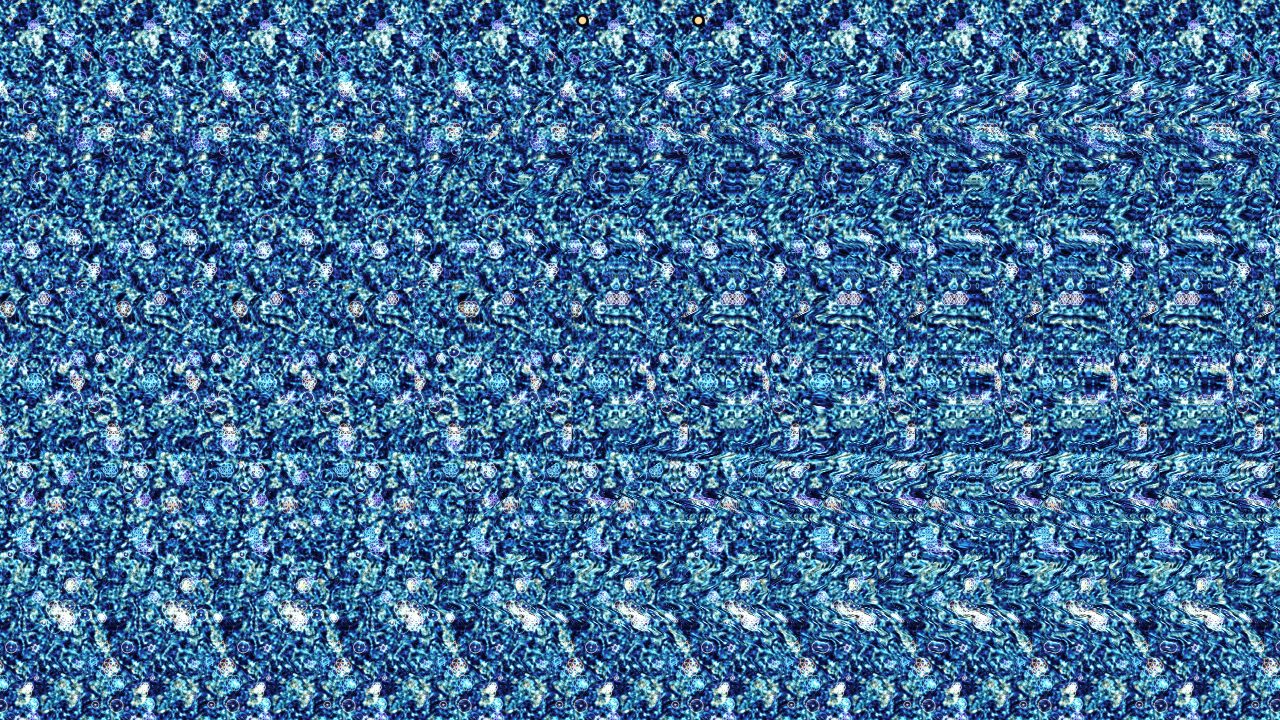
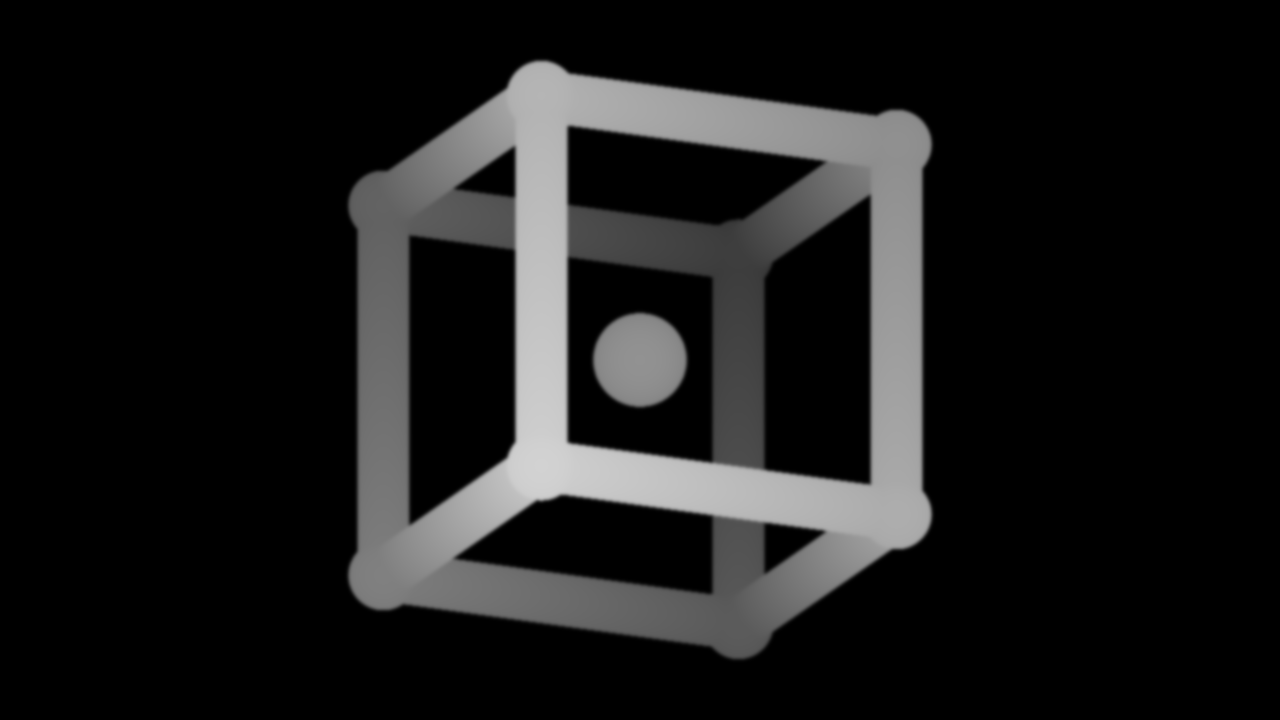
At first glance a magic eye image (properly called an autostereogram) looks like wallpaper: a pattern repeating across the page. But if you let your eyes aim at a point behind the screen while keeping the image in focus, a shape can rise out of the pattern and float in depth. In our practice image, a wireframe Necker cube appears, with a small sphere at its center. Unlike the flat line drawing, which keeps flipping, the cube seen in depth points one way only: the depth information settles which face is in front.
Nothing in the picture outlines that shape, and if you cover one eye it disappears. It exists only when your brain combines the slightly different views from your two eyes. That makes the magic eye a direct look at how vision builds a three-dimensional world out of two flat images.
A little history
In 1838 the physicist Charles Wheatstone showed how much our sense of depth depends on the small differences between what the left and right eyes see. He built the first stereoscope, a mirror device that presented a separate drawing to each eye, and found that two flat drawings, each made from a slightly different viewpoint, fuse into a single solid-looking form.
In 1960 Bela Julesz, working at Bell Labs, used a computer to make random-dot stereograms: two fields of random dots, identical except that one region was shifted slightly sideways in one of them. Each image on its own shows nothing but noise, yet in a stereoscope a shape pops out in depth. This showed that the brain can match the two eyes' images and compute depth before it recognizes any object at all. Julesz explored the idea at length in his 1971 book Foundations of Cyclopean Perception.
The step to a single picture came in 1979, when Christopher Tyler and M. B. Clarke worked out how to fold the two images of a random-dot stereogram into one repeating pattern: the single-image stereogram, or autostereogram. It built on an older observation, which they trace to David Brewster in 1844, that repeating wallpaper patterns can seem to float when the eyes pair up neighboring repeats. In the early 1990s Tom Baccei and Cheri Smith turned the technique into colorful printed images under the Magic Eye name, and their 1993 book Magic Eye: A New Way of Looking at the World became a number-one New York Times bestseller.
What the science says
Because your eyes sit a few centimeters apart, each sees the world from a slightly different angle, so nearby objects land in slightly different places on the two retinas. The brain uses this binocular disparity as a powerful cue to depth. An autostereogram exploits it. The pattern repeats at a regular interval, and wherever the hidden shape should stand out, that interval is subtly changed. When each eye lines up on a neighboring repeat, those changes become disparities, and the brain does what it always does with disparities: it sees depth.
The tricky part is what your eyes have to do. Normally two systems move together: vergence (how far the eyes turn inward or outward) and accommodation (how the lens of each eye focuses). Look at something near and both adjust for near; look far away and both relax. An autostereogram asks you to separate them, aiming your eyes as if at something behind the screen while keeping your focus on the screen itself. That is why the skill feels strange at first. Research on 3D displays has found that this kind of mismatch between vergence and focus makes viewing harder and can cause visual fatigue (Hoffman et al., 2008), so short sessions with breaks are sensible.
Most people can learn it. Tyler and Clarke reported that most observers picked it up within a first session of five to ten minutes, though some find it hard. Because the effect depends on both eyes working together, anyone without stereo vision will not see the depth, and that is not a failure of practice.
The meditation connection
This section is our interpretation, offered as a way of practicing, not a research finding.
The most common reason people don't see the hidden image is effort. Trying harder tends to pull the eyes back to the surface of the screen, and the shape stays hidden. What works is closer to letting go: softening the gaze, being patient with a little blur, and allowing the eyes to drift until the pattern locks into place.
That makes the magic eye a good training ground for a meditative quality of attention: alert but relaxed, interested but not grasping. Once the shape appears there is a second lesson. The cube and the sphere inside it look vividly solid, yet you know they exist nowhere on the page. Watching something so convincing arise from the mind's own construction can loosen, a little, our certainty that the world simply is as it appears.
If your eyes feel tired or strained, stop and rest. The exercise is meant to be gentle.
Sources
Tyler, C. W. Autostereogram. Scholarpedia.
Smith, C. (1993). Magic Eye: A New Way of Looking at the World. Andrews McMeel Publishing.