What you see isn't fully real, and it can't be
Look around the room. It feels like you are looking straight out at the world. You aren't. What you are seeing is a picture your brain has built, and you can prove it in about a minute.
Light takes time to reach your eyes, and your brain takes roughly a tenth of a second more to turn it into a scene, so everything you see is a slightly delayed reconstruction. Each eye has a blind spot where the optic nerve leaves, with no light sensors at all, yet you never see a hole, because your brain paints it in. Only a small patch at the center of your vision, the fovea, sees in sharp detail; the crisp, full-color world around you is mostly filled in. Your eyes jump several times a second, and during each jump your brain quietly suppresses the blur, so you never notice the gaps. Even color is made inside you. Light has wavelengths, not colors; red is something the brain adds.
Put simply, perception works like the desktop on a computer. The desktop isn't the code inside it. It's a way to quickly and efficiently act and work. What you see is your brain's desktop, a projection, and once you notice that, meditation becomes much easier to understand.
Try it yourself
You don't have to take any of this on faith. Each of these takes less than a minute.
1. Find your blind spot
Close your left eye, look at the cross with your right eye, and slowly move closer to the screen until the dot disappears.

Your brain did not leave a hole; it filled the gap with the background. You were looking at something that isn't there.
2. Watch the Necker cube flip
Rest your eyes on the wireframe cube and wait; the front face will suddenly become the back face.
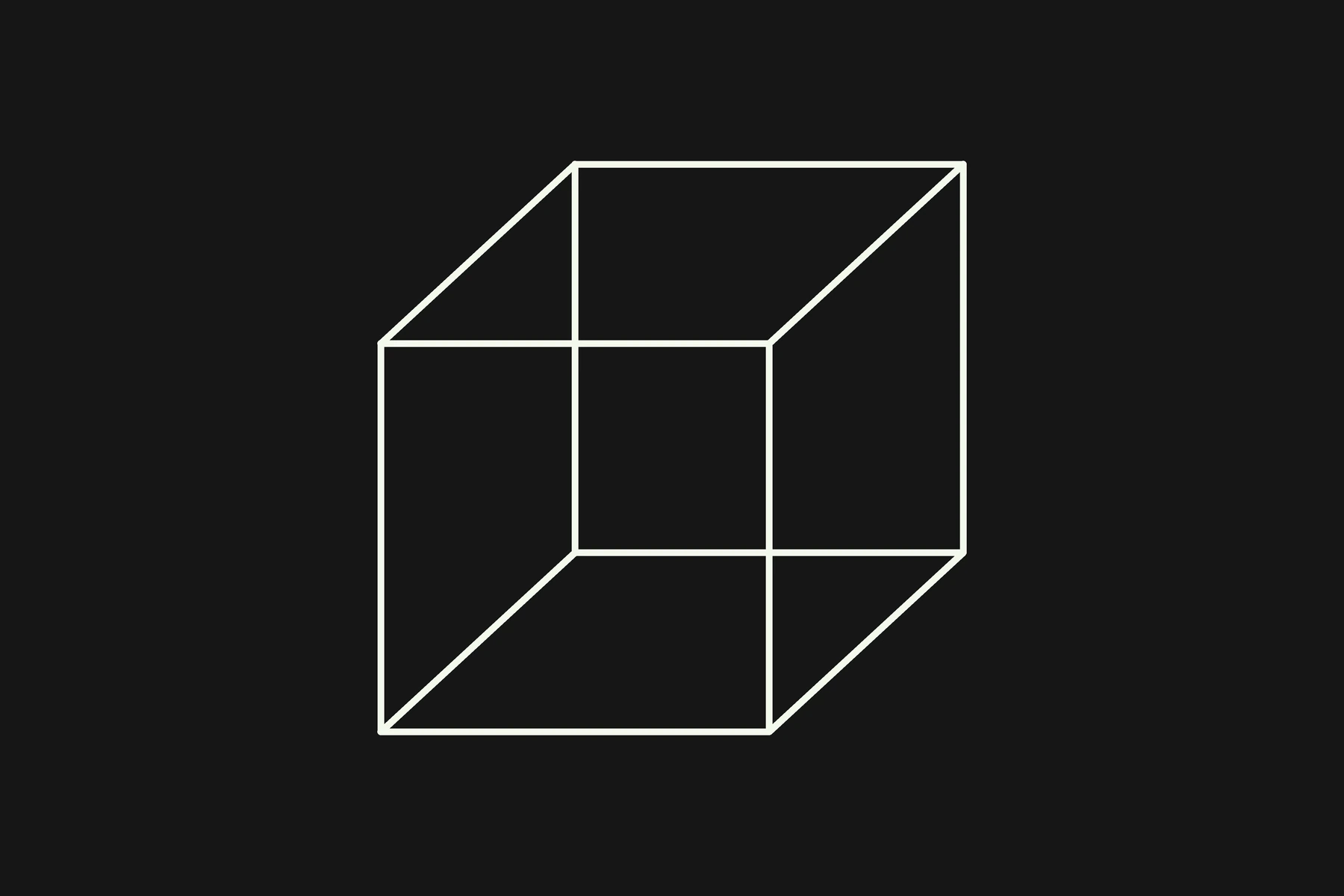
Nothing on the screen changed at all. Same input, two different worlds, and your brain chooses which one you live in.
3. Look at the hollow face
Watch the rotating mask as it turns to show its hollow inside.

The inside still looks like a face pushing out toward you. Your brain's expectation that faces are convex is strong enough to overrule the actual shape.
“Hollow face illusion” by cmglee and hong227, via Wikimedia Commons, CC BY-SA 4.0 (converted to WebP).

4. Compare the two squares
In the checkerboard, square A looks dark and square B, in the cylinder's shadow, looks light. Cover everything else with your fingers and see.
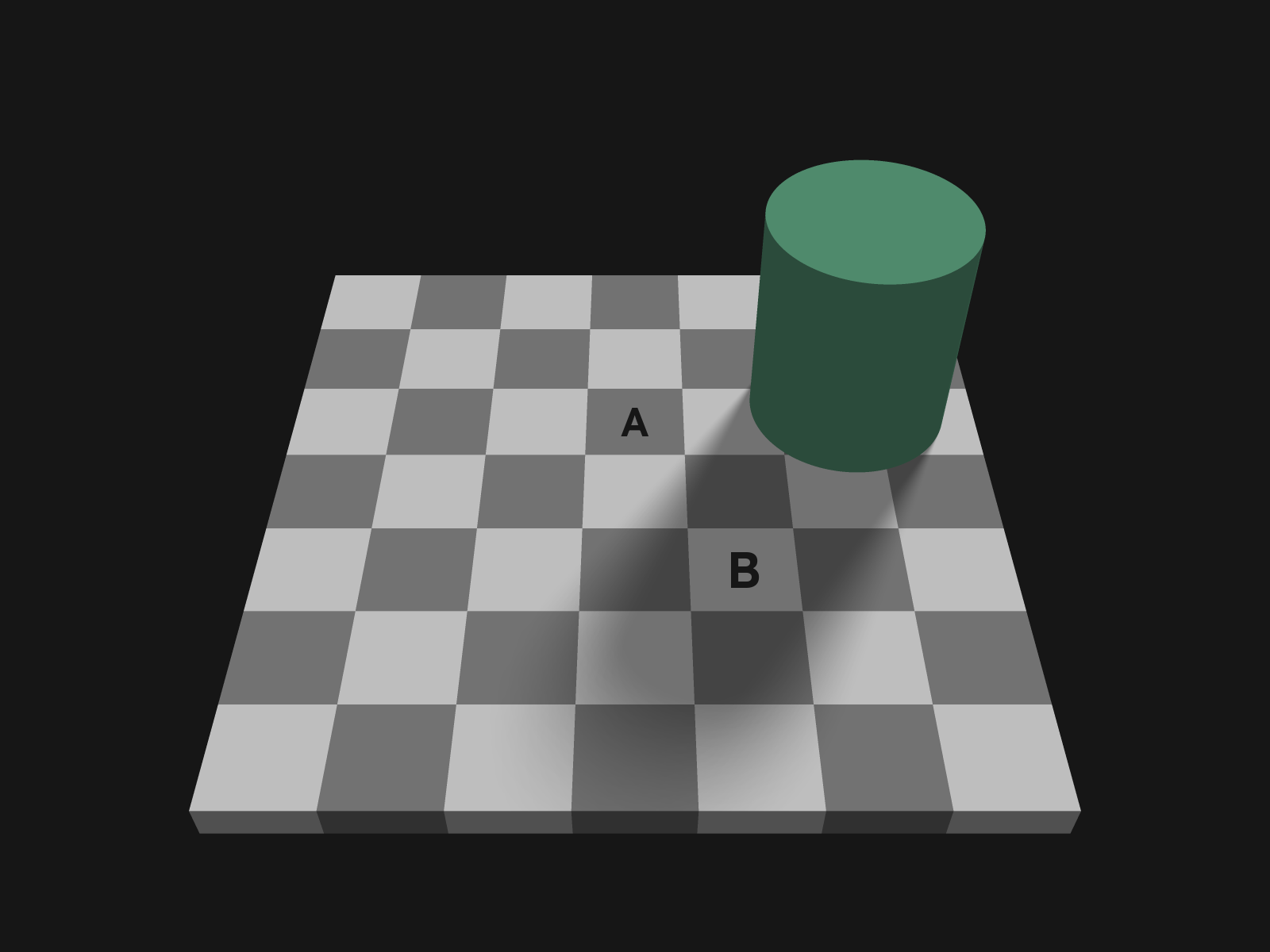
They are exactly the same shade of gray. Your brain corrects for the shadow and shows you what it thinks the surface is, not the light that is reaching your eye.
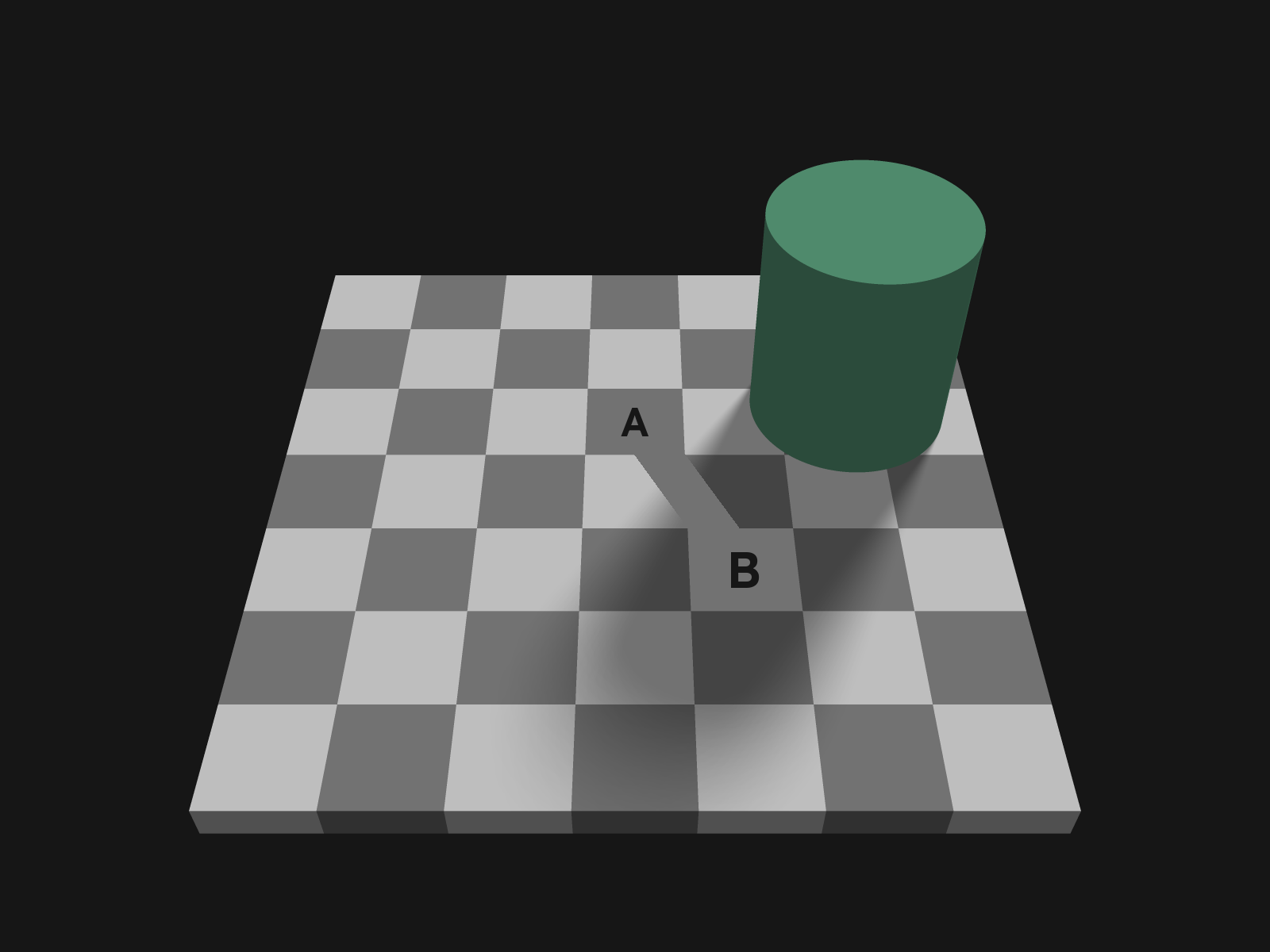
Same gray. Your brain corrected for the shadow.
5. Spot the change
Something disappears and reappears. Can you spot it?
This image flickers. If you have photosensitive epilepsy, or flashing images bother you, skip this one.
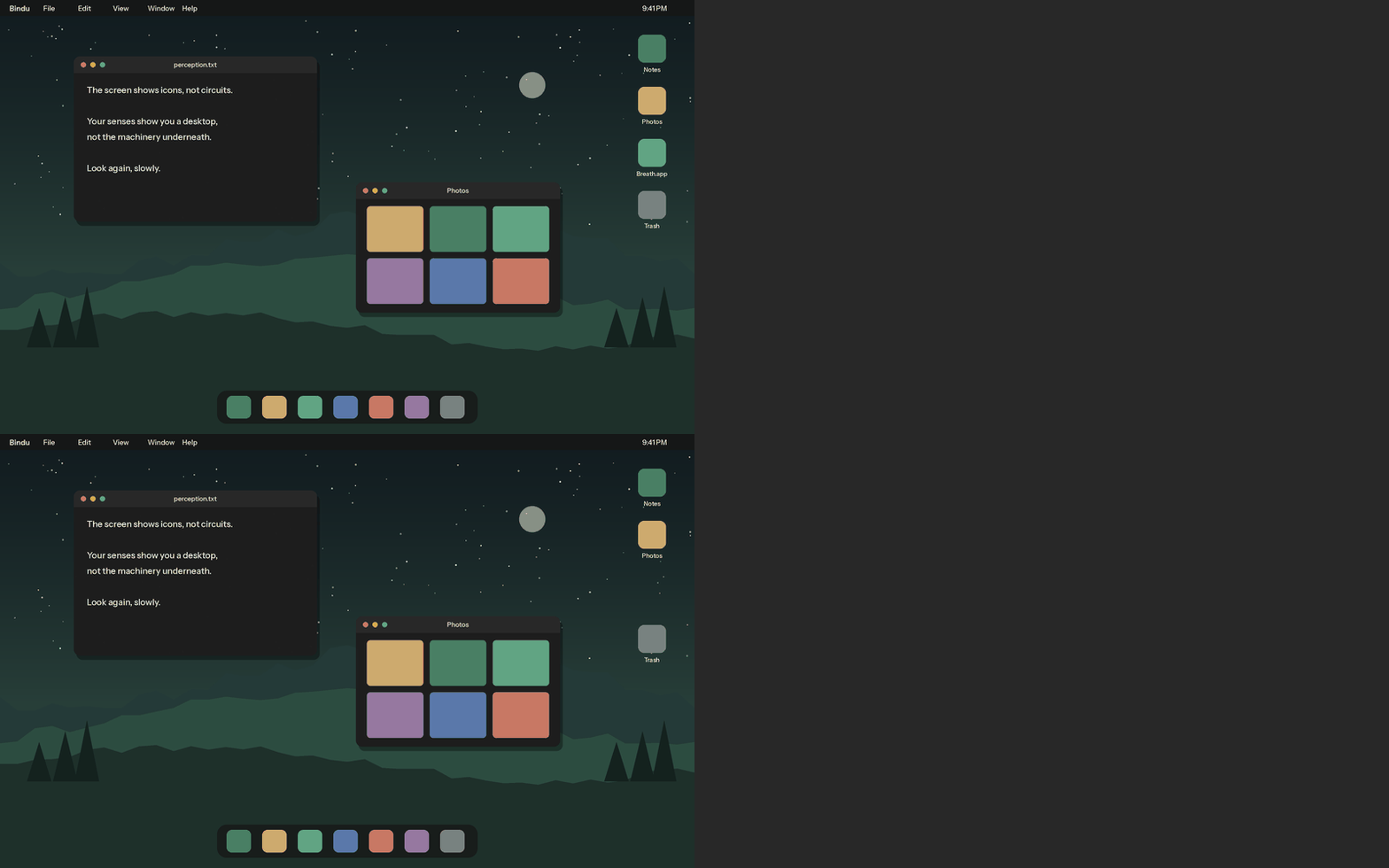
It can take a surprisingly long time to find, even though it is in plain view. The same thing happens in the well-known selective-attention test, where about half of first-time viewers counting basketball passes miss something very obvious walking through the scene. What you see is what your attention selects, not everything in front of you.
Answer: the green Breath.app icon, third in the column of desktop icons on the right, vanishes and returns.
Each demonstration shows the same thing. The world arrives as raw signals, and your brain builds a version of it. Most of the time the building is invisible. Illusions are where you catch it happening.
Perception is a desktop
Cognitive scientist Donald Hoffman puts it in the clearest way we know. Think about the desktop on your computer. You see icons, folders, and a trash can. You drag a file to the trash and it's gone. None of that is what is actually happening inside the machine. Underneath are voltages, circuits, and millions of lines of code. The blue icon is not blue inside the computer, and the trash can contains no trash. The desktop hides all that complexity on purpose, so you can act quickly. If you had to flip voltages by hand to send an email, you would never send one.
As Hoffman writes in The Case Against Reality:
“The purpose of a desktop interface is not to show you the ‘truth’ of the computer… Rather, the purpose of an interface is to hide the ‘truth’ and to show simple graphics that help you perform useful tasks such as crafting emails and editing photos.”
— Donald D. Hoffman, The Case Against Reality: Why Evolution Hid the Truth from Our Eyes (2019)
It is there to help you get things done: the desktop isn't the code inside it, it's a way to act and work quickly and efficiently.
Perception does exactly the same job. The tree, the cup, and the face across the table are icons. They are your brain's desktop, not the underlying reality, and they were built for quick, efficient action rather than for truth.
Hoffman argues that evolution built perception the same way. Using evolutionary game simulations, he and his colleagues found that creatures tuned to what helps them survive tend to outcompete creatures that see the world as it is. He calls this “fitness beats truth.” The apple, the snake, and the speeding car are icons. Take them seriously, because they keep you alive, but don't take them literally. They are useful, not literal.
Here is why this matters for meditation. You can't step outside the desktop, but awareness can notice the desktop as a desktop. When you notice, you are no longer completely lost in the icons. Something in you is watching the screen. That watching is what meditation trains.
Other scientists say this too
Hoffman is not alone. The idea that perception is constructed runs through centuries of science and philosophy.
- Immanuel Kant distinguished phenomena, things as they appear to us, from noumena, things as they are in themselves, which he held we can never directly know.
- Hermann von Helmholtz, the 19th-century physicist and physiologist, described perception as unconscious inference: the brain draws quick, hidden conclusions about what must be causing the signals at the eye.
- Richard Gregory, the British psychologist, argued that perceptions are hypotheses, the brain's best guesses that get tested against incoming data. He used the hollow face as a favorite example.
- Rodolfo Llinás, neuroscientist at NYU, argues in I of the Vortex that the waking state is itself dreamlike, a brain-made model that the senses guide and shape, while ordinary dreaming runs without the senses at all.
- Karl Friston and Andy Clark developed predictive processing, the view that the brain is constantly predicting its own input and that what we experience is mostly those predictions, corrected by error signals from the senses.
- Anil Seth, neuroscientist at the University of Sussex and author of Being You, calls perception a “controlled hallucination.”
- Thomas Metzinger, philosopher and author of The Ego Tunnel, argues that the brain builds a model of the world and also a model of a self inside it. We don't experience the model as a model, so it feels like simply “me.”
“In fact, we're all hallucinating all the time, including right now. It's just that when we agree about our hallucinations, we call that reality.”
— Anil Seth, “Your brain hallucinates your conscious reality,” TED2017
The physicist John Archibald Wheeler took the question further. Reflecting on quantum mechanics, he described a “participatory universe,” in which observation is not a passive window onto a finished world. In some sense the act of observing helps bring definite reality into being. Physicists still debate what this means, but it shows that even at the foundations of physics, the observer cannot be fully left out of the picture.
What the contemplatives saw
Long before brain scans, meditators described the same thing from the inside. They didn't talk about predictive models. They talked about mind, appearance, and the awareness that sees them.
“All conditioned dharmas / Are like a dream, an illusion, a bubble, a shadow / Like dew and like lightning / Thus they should be perceived.”
— The Diamond Sutra, closing verse (Kumārajīva's Chinese, tr. Venerable Yifa)
“Here, Shariputra, form is emptiness, emptiness is form; emptiness is not separate from form, form is not separate from emptiness.”
— The Heart Sutra, tr. Red Pine
“Just as the spider emits the thread (of the web) out of itself and again withdraws it into itself, likewise the mind projects the world out of itself and again resolves it into itself.”
— Ramana Maharshi, Who Am I? (Nan Yar), tr. T.M.P. Mahadevan
“Resolutely remind yourself that you are not the mind and that its problems are not yours.”
— Nisargadatta Maharaj, I Am That, ch. 31, “Do Not Undervalue Attention”
“Let go of what has passed. Let go of what may come. Let go of what is happening now. Don't try to figure anything out. Don't try to make anything happen. Relax, right now, and rest.”
— Tilopa, Six Words of Advice, tr. Ken McLeod
Notice the word Ramana uses: projects. The language is a thousand years older than the computer, but the insight is the same.
Separating mind from awareness
At its heart, meditation is about separating mind from awareness.
By mind we mean everything that runs on the desktop: the projected world, the stream of thoughts, the commentary, and the story of who you are. By awareness we mean that which notices all of it. Usually the two are fused. We are so absorbed in the projection that we take it to be both the world and ourselves.
Illusions pull them apart for a moment. When the Necker cube flips, the picture changes, but you don't. You are the one who noticed it flip. The cube was the projection; the noticing was awareness. The same goes for the gray squares, the vanishing dot, and the hollow face. Each time, you watch your own mind build something, and you are standing slightly outside the building.
That is why illusions are an easier doorway. Telling someone to “observe their thoughts” is abstract. Asking someone to watch a cube flip is concrete and immediate, and it works on the first try. Once you have felt the difference between what changed and the one who noticed, you can bring that same noticing to a thought, a feeling, or the sense of self. The practices on Bindu Tessera are built to train exactly that.
Working theory
The world in front of you stays the same while you practice. What changes is your mind, and its perception and projection of the world. The view behind Bindu Tessera is that repeated practice with visual illusions makes the projection easier to see in everyday life, and that seeing the desktop as a desktop is the beginning of freedom from being run by it.
To be clear about where the line falls: the constructive nature of perception is well-established science, and the connection we draw from it to meditation and awareness is our interpretation, in good company with the traditions above.
Start practicing
The best way to understand this is to try it. Pick a practice and spend five quiet minutes with it.
- Try the Necker cube practice: watch the flip, and then notice who is watching.
- Try the magic eye practice: let your eyes soften until a hidden 3D world appears out of flat noise.
- Try the mandala practice: rest your attention at the center and let the pattern hold you.
If you want to go deeper, read The Theory for the full argument and The Vision for where Bindu Tessera is headed. Bindu Tessera is free while in beta.
Sources
Adelson, E. H. (1995). Checker-shadow illusion. MIT Perceptual Science Group.
Clark, A. (2016). Surfing Uncertainty: Prediction, Action, and the Embodied Mind. Oxford University Press.
Helmholtz, H. von (1867). Handbuch der physiologischen Optik (Treatise on Physiological Optics), vol. 3.
Hoffman, D. D. (2019). The Case Against Reality: Why Evolution Hid the Truth from Our Eyes. W. W. Norton.
Kant, I. (1781/1787). Critique of Pure Reason.
Llinás, R. R. (2001). I of the Vortex: From Neurons to Self. MIT Press.
Metzinger, T. (2009). The Ego Tunnel: The Science of the Mind and the Myth of the Self. Basic Books.
Seth, A. (2017). Your brain hallucinates your conscious reality. TED2017.
Seth, A. (2021). Being You: A New Science of Consciousness. Faber & Faber / Dutton.
The Diamond Sutra (Vajracchedikā Prajñāpāramitā), sec. 32, Kumārajīva's Chinese (T235), tr. Venerable Yifa (via NTI Reader).
The Heart Sutra (Prajñāpāramitā Hṛdaya). tr. Red Pine, The Heart Sutra: The Womb of Buddhas (Shoemaker & Hoard, 2004).
Ramana Maharshi. Who Am I? (Nan Yar), q. 8, tr. T.M.P. Mahadevan. Sri Ramanasramam.
Nisargadatta Maharaj (1973). I Am That, ch. 31, tr. Maurice Frydman, ed. Sudhakar S. Dikshit. Chetana.
Tilopa. Six Words of Advice, tr. Ken McLeod (Unfettered Mind).
Hollow-face animation: “Hollow face illusion” by cmglee and hong227, Wikimedia Commons, CC BY-SA 4.0. All other illustrations on this page are original to Bindu Tessera.